The One-Time Access Configuration Pattern That Eliminates the Engineer-as-Query-Proxy Loop
Self-service data access eliminates the engineer bottleneck through governed infrastructure.
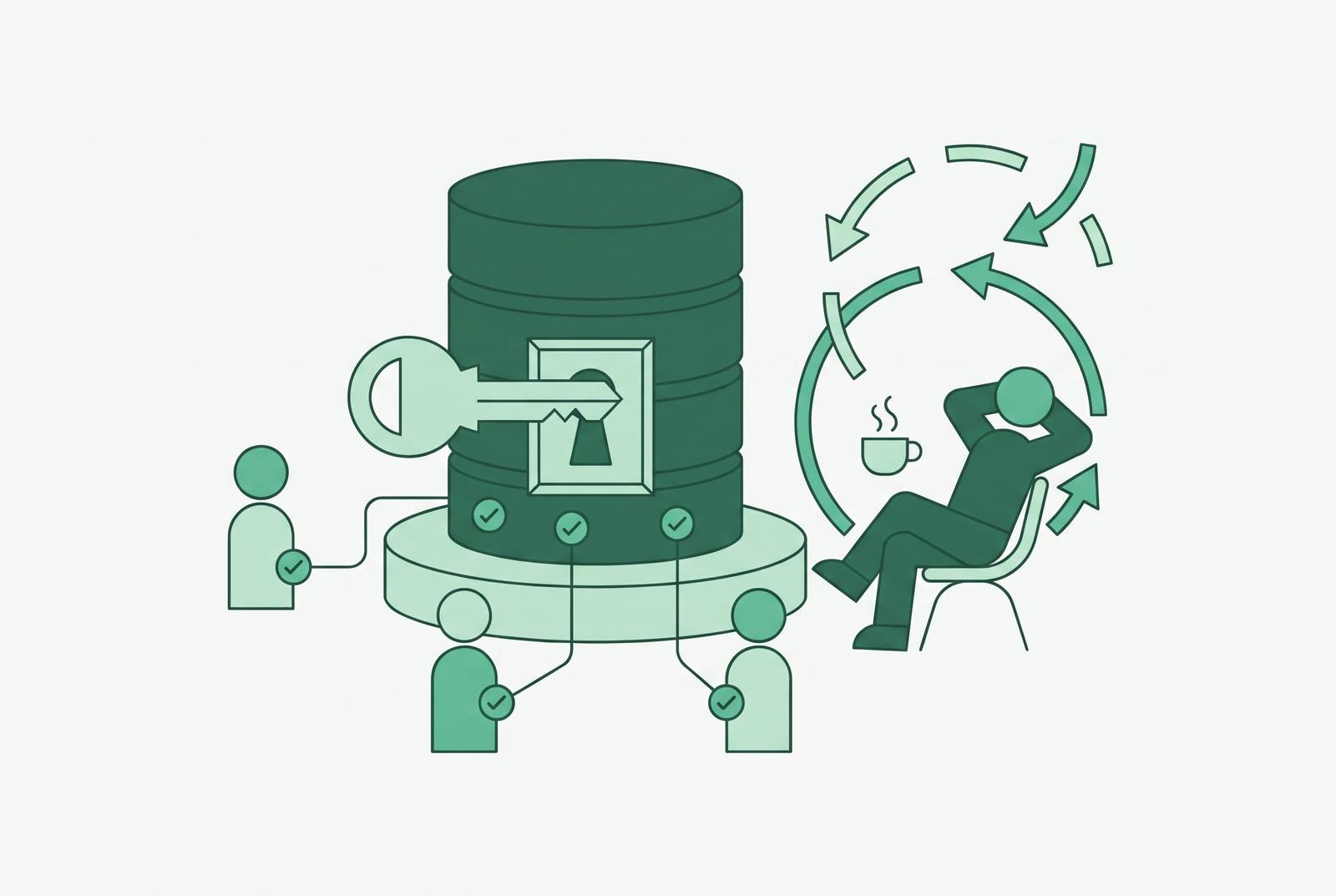
For a small startup, the right database interface lets non-technical teams query governed views without SQL, while engineering controls permissions, shared metric definitions, and production safeguards. The engineer-as-query-proxy loop ends when those controls become reusable infrastructure.
Why the engineer-as-query-proxy loop is a structural problem, not a staffing one
Someone sends a message in the workplace chat asking for last week’s revenue. An engineer writes the SQL, exports a CSV, and returns to work. Two hours later, the message returns with a small amendment, asking for revenue by region. Then someone wants test accounts excluded, followed by a year-over-year comparison. The query is small, but the interruption repeats.
Every variation passes through a central team because only that team can turn a business question into an approved answer. Hiring another engineer adds someone to work through the queue, but the queue still works the same way. Meanwhile, what the team knows about table quirks, metric definitions, and join-path traps stays in someone’s head. When that person is away, even a question they have answered before is hard to answer.
Even with faster SQL, the team still depends on that person. Engineers who work faster can make more things that need support, so more work goes through the same narrow channel. Nor does handing everything to analysts without supervision solve the problem, because it trades waiting time for data quality and compliance risk. The architectural task is to separate engineering’s control over the data from engineering’s participation in every request.
Why the Airbnb and JetBlue experiences show that centralizing data work cannot scale
The detailed evidence here concerns JetBlue’s centralized transformation work. JetBlue kept all transformation logic inside its engineering team on a legacy Microsoft SSIS/APS on-premises stack, preventing analysts from iterating independently. It took eight hours to run its pipeline jobs. During that window, the warehouse was unavailable to analysts, so the dependency involved both who could change the logic and when anyone could use the result.
JetBlue adopted Snowflake and dbt to remove that centralized bottleneck and enable analyst self-service. The distinction is important because the analyst lockout belonged to the legacy system. This was not simply a request for engineers to type faster. Changing the platform and the ownership model gave analysts a path that did not require engineering to perform every transformation on their behalf.
The supplied material does not give a comparable account of another company’s changes, so it cannot support a claim about that company’s results or timescale. JetBlue’s experience nevertheless establishes the relevant mechanism. A central team can become the mandatory passage for work even in an organization with engineers and budget. More resources cannot, by themselves, remove a dependency built into the workflow.
What “configure once” actually means through four components of a governed access layer
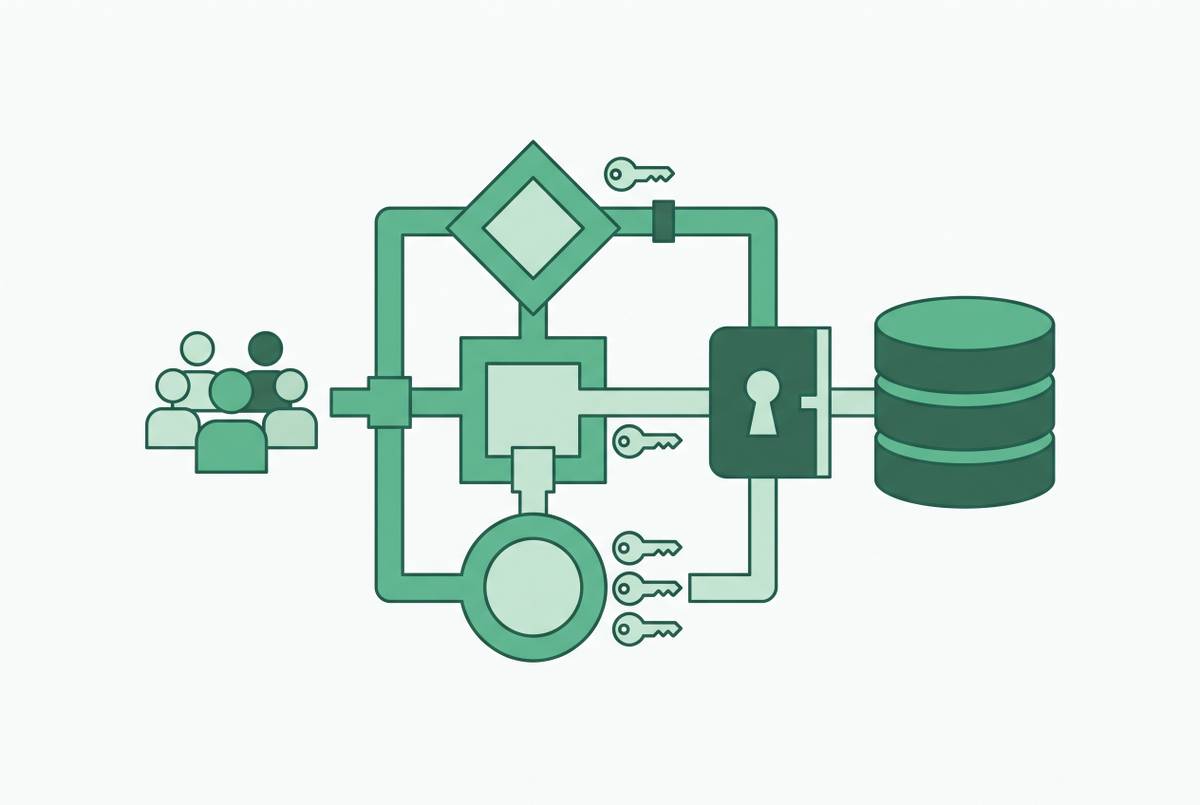
For an engineering lead, the configuration translates into four concrete pieces of work. The first is a database-level read-only role with SELECT permissions only on the tables the application needs to query, and no INSERT, UPDATE, or DELETE permissions. The database engine enforces this boundary. The same restriction applies to a human, a BI tool, or an AI query generator. Writes remain on a separate, tightly scoped grant.
The second piece is per-user SSO identity, so each user has their own credentials. Each business user gets a login and a read-only path, while the database password stays on the server. Every statement should land in an audit log under that user’s name. Without individual identity, the log cannot establish who ran a query when compliance work or a disputed answer requires that information.
The third component is a read replica to protect production. A full table scan or accidental cross join can still slow real traffic, so the replica contains the blast radius. If there is no replica, a statement timeout is the minimum safeguard against a runaway query. Separating analytical access also supports GDPR and similar compliance requirements by limiting exposure of personal data to read paths.
The fourth component is a semantic layer containing shared metric definitions and business logic. Data teams define metrics once, and downstream tools inherit those definitions. Defined views and saved queries give users a reusable route to those metrics. Without that structure, opening access simply gives more people the means to calculate different answers to the same question.
How the semantic layer handles the objection that self-serve just moves the bottleneck to interpretation
The strongest objection is about meaning. A user can have valid SELECT access and still come up with a number the CFO would not recognize as revenue. A dashboard, a BI tool, and an AI agent can then produce conflicting numbers, each dressed with the confidence of a decimal point. Engineering has escaped the export desk only to join the arbitration panel. That is not much of a promotion.
The semantic layer prevents that particular failure by giving business terms an authoritative definition. Every downstream query, including AI-generated SQL, resolves business terms against the agreed definitions. Scoped subagents can likewise be loaded with finance’s revenue definition and a standing rule to exclude test accounts.
There is a real cost to doing this. Someone must settle the definitions, encode them, and expose them through a governed path while the existing request queue is still arriving. The investment is finite for each defined metric, though it is not a promise that business logic will never change. Once net revenue is defined, another request for that metric should not require an engineer to reconstruct its meaning.
What Pinterest’s two-year build shows about the platform work that makes self-serve real
In 2024, Pinterest put text-to-SQL inside Querybook, its in-house query tool, and reported a 35% faster SQL task completion speed. Pinterest published that result even though it was lower than lab studies suggested. The first iteration fell short of expectations.
The second iteration added retrieval over embeddings of a very large table corpus. First-shot SQL acceptance rose from roughly one-in-five to better than two-in-five. Table context made a measurable difference to correctness. The sequence is instructive because the improvement came from giving the system better grounds for choosing and using data, rather than merely asking users to phrase their questions more carefully.
By March 2026, the Pinterest Analytics Agent turned past SQL into natural-language descriptions of what the analysis was meant to do. It then embedded those descriptions as unified context-intent embeddings, which helped the agent understand the business questions behind the table names. Within two months, it reached a large share of the analyst population and became the company’s most-used internal agent. It far outpaced the next most-used internal agent.
The less visible foundation was an internal vector-database service built to prevent separate LLM-feature teams from creating one-off vector infrastructure. Pinterest’s two-year progression therefore shows that building an agent requires preparing the access, context, and governance it needs. The upfront work was substantial, but it was not work that had to be repeated for every analyst’s question.
What the engineering team’s role becomes after the access layer is in place
Engineers still own the foundations after self-service begins. Their work shifts toward core datasets and foundational pipelines that other teams build from. In practice, that includes maintaining the read replica, auditing role grants, and reviewing semantic definitions when business logic changes. Timeouts, row limits, and permission scopes remain engineering responsibilities. These safeguards protect production without making an engineer the doorman for each query.
The unit of work changes from request to template. Instead of provisioning the fiftieth ad-hoc query by hand, the team maintains a reusable route to the answer. It owns the definition of revenue those departments use, so it no longer has to check each department’s version. That is a more durable use of engineering skill. It also lets an analyst operate production-grade pipeline logic where the platform has made that work safe enough.
Shopify offers a parallel in a different setting. Roughly six engineers own the LLM proxy infrastructure through which every AI request in the company runs. For data access, encoding table quirks, metric definitions, and join-path traps in the semantic layer and saved queries also makes that knowledge survive an engineer’s absence or departure.
How do non-technical teams query data without SQL or renewed engineering dependency?
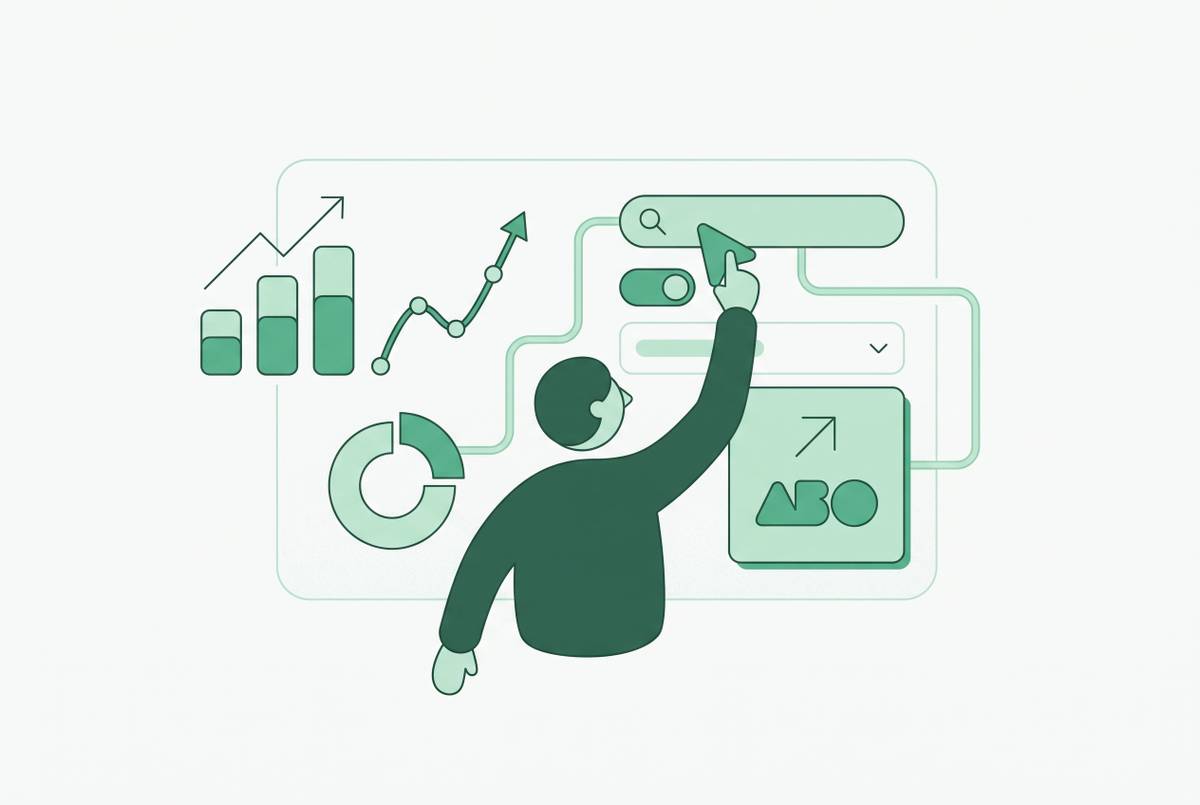
For a growing startup, the useful database-interface test is whether product, sales, marketing, and support can ask a new question without opening a SQL editor or filing a ticket. A friendly screen is not enough on its own. The interface must expose the governed layer while preserving engineering’s control over what users can see and edit. Otherwise, the tool changes the appearance of the handoff without removing it.
Row-level permissions are a decisive requirement. A sales rep should see only their accounts, while a support agent should see only their tickets. Broad read access creates both unnecessary exposure and noise. Saved queries and defined views should also mirror the semantic layer, making revenue a named, reusable query rather than an invitation to invent another definition. The business user needs an answerable question.
Setup burden belongs in the evaluation too. Weeks of data-team configuration before a business user can self-serve may simply relocate the bottleneck to onboarding. Engineering should set permissions and decide what other teams can see, so those teams can work on their own within those limits. For organizations in the Microsoft ecosystem, Power BI offers a lower per-user cost as an alternative evaluation point. Its fit depends on price, existing Microsoft licensing, and whether the connection needs to reach a production database or a warehouse layer.
The one-time investment case through finite configuration cost and permanent queue savings
Under the proxy model, more employees bring more questions and more tickets, even when the underlying definitions barely change. Under the governed model, a request for a metric that is already defined can be answered without taking more of an engineer’s time. It removes the recurring human toll for answering a supported question while compute and maintenance still carry costs.
The transition still requires doing two jobs briefly. A team must build the access layer while continuing to handle requests that have not yet moved onto it. Opening self-service before the semantic layer, row-level permissions, production safeguards, and saved queries are ready only exchanges one queue for another. The upfront configuration is bounded work, while future business changes create maintenance rather than a reason to rebuild each answer from scratch.
AI does not remove that investment requirement. Generating SQL is different from deciding what the company means by net revenue, and an ungoverned model can accelerate metric drift as readily as query writing. The semantic layer keeps generated output anchored to agreed definitions.
A team already spending meaningful hours each week on proxy queries is paying for data access in interruptions and repeated work. The choice is whether to keep buying each answer separately or spend the upfront time defining a governed path that others can use. The next recurring metric can become another ticket, or the next piece of configuration that retires one.