Single Source of Truth vs Federated Semantic Layers
Centralized metrics prevent the same data from telling different stories to different teams.
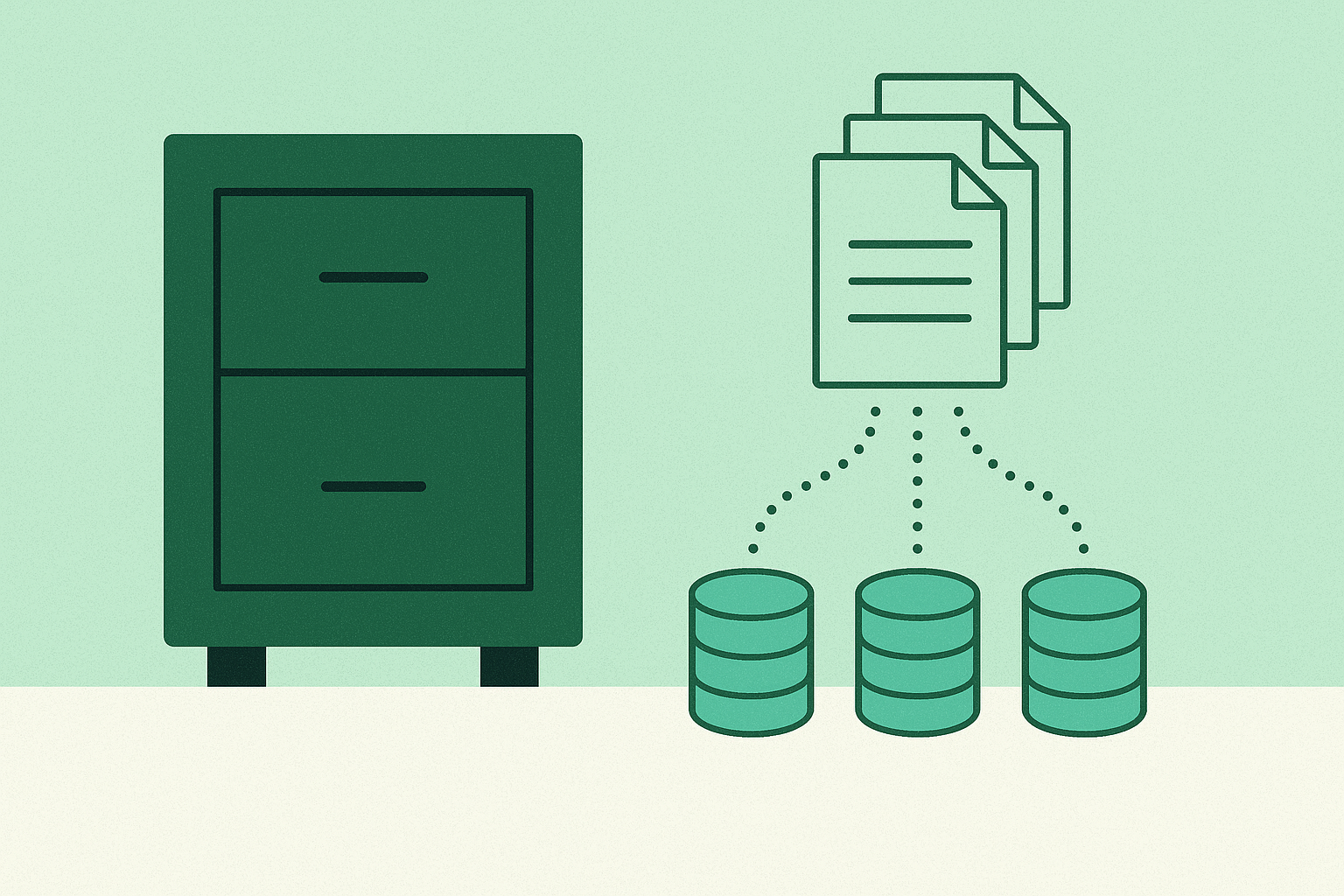
Picture three people walking into the same meeting, each holding a chart that says "revenue," and each chart showing a different number. Nobody's lying. Finance counted earned income recognized on delivery, the accrual basis they're required to use. Sales counted signed contract value, because that's what their comp plans run on. Marketing used a transaction threshold, because that's the number their funnel math needs. Three departments, three "revenue" figures, one meeting that turns into an argument about whose math is wrong when nobody's math is actually wrong.
That's the starting point for this piece: single source of truth architecture versus federated semantic layers, and the trade-offs that come with each. Friction can't be eliminated; it just moves. It just moves.
Why the same metric can mean different things in every tool that queries it
Without a shared definition layer, every team, and every tool that team uses, builds its own private version of the business logic. "Active users" in the product dashboard means something different than "active users" in the finance spreadsheet, and something different again in whatever SQL query someone wrote last Tuesday to answer a one-off question from a VP.
This isn't a training issue, and it isn't a people issue. Nobody needs a workshop on what revenue means. The same underlying data produces contradicting answers because the meaning attached to that data lives in five different places instead of one, built into the architecture itself. Finance, Sales, and Marketing aren't disagreeing because they're careless. Each team built a definition that made sense for its own job, and nothing ever forced those three definitions to meet in the middle.
Databricks calls the downstream effect "decision debt." Ambiguity about what a number means piles up the same way technical debt does, and it gets paid off in reconciliation meetings, duplicated work, and the kind of missed opportunity that comes from three teams debating definitions instead of acting on what the data is actually telling them.
The pattern gets worse with scale, not better. A centralized definition of metrics, dimensions, relationships, and access rules sits between the warehouse and everything downstream, so the translation from raw tables to business meaning happens exactly once and then travels to every tool that needs it.
AtScale frames the semantic layer as standardizing five things: metrics (how "churn rate" actually gets calculated), dimensions (customer segments, time periods), relationships (how tables join to each other), business terminology, and access rules. Get those five things centralized, and the define-once-use-everywhere principle kicks in. Change a metric in one place, and that change shows up automatically in every dashboard, notebook, AI agent, and API that reads from it. Databricks also points out what happens without that layer: row-level security, column masking, and other governance rules have to be rebuilt by hand inside every single tool, which is exactly the kind of fragile, error-prone setup that falls apart the moment someone forgets to update one of the five places it's defined.
What a semantic layer governs
A semantic layer is a set of capabilities that can live in different parts of the data stack depending on how an organization builds it. Where it lives decides who controls it, who's allowed to change it, and which tools can actually read from it.
Coalesce breaks the core components into four pieces. Synonyms and natural-language metadata give the whole system a human vocabulary, which matters most when an AI tool is trying to translate a plain-English question into a query.
That's a different animal than a folder of SQL views scattered across a warehouse with no documentation and no link back to a shared glossary, and it's different again from formulas buried inside a dashboard that only that dashboard can see. A real semantic layer is centralized, versioned, testable, and written in code, the same way application code is. The column name is just a technical label. The metric is what the organization actually knows.
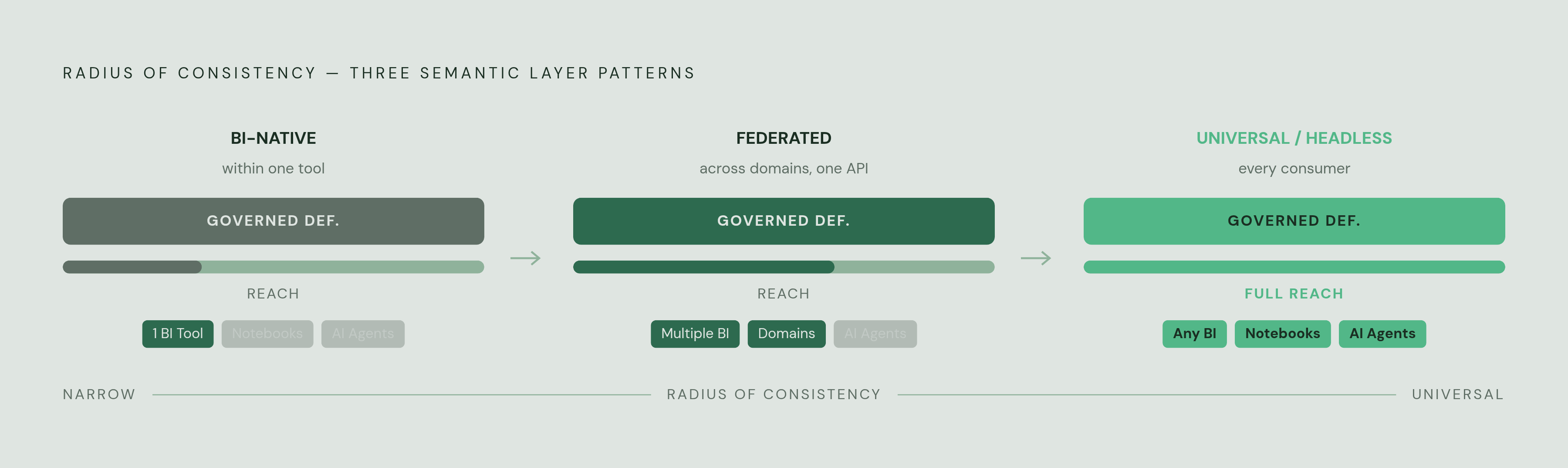
Three architectural patterns answer the question of where that governed layer lives, and each draws the boundary of consistency in a different place. A universal or headless layer sits above the warehouse as its own standalone piece, exposing governed metrics over an API to any consumer, whether that's a dashboard, an AI agent, or a notebook, regardless of which BI tool happens to be in use that week.
A BI-native layer only solves consistency for as long as everyone in the organization uses that one BI tool, which rarely holds for more than a year or two. Adding a semantic layer is a family of choices, each with a different radius of consistency, and the rest of this piece is about two ways organizations tend to answer it.
What a single source of truth architecture bets on
A single source of truth architecture makes a specific bet: that maintaining one authoritative definition layer costs less, over time, than reconciling divergent definitions across every team that touches the data. It also bets that the organization can keep one team in charge of that layer indefinitely, without that team turning into a traffic jam.
When it works, every tool, every notebook, every platform pulls from the same business definitions: same metrics, same hierarchies, same logic. There's no reconciliation step because there's nothing to reconcile. Databricks lays out the concrete payoff: every BI tool, every notebook, every natural-language interface returns the same answer to the same question. Governance policies travel along with each metric definition instead of getting rebuilt by hand in every tool that touches it.
Access control becomes part of how every query gets built in the first place, instead of something bolted on after the fact, which is what makes self-service analytics actually usable for teams without a SQL background, product, sales, marketing, support. They're querying business concepts, not tables, and they can trust that the number on their screen matches the number Finance is looking at.
Semantic leakage, the slow forking of metric definitions across tools and teams, is exactly the failure mode a central layer exists to stop. Definitions don't drift because somebody got sloppy. They drift because "active user" or "quarterly revenue" gets quietly redefined every time a new tool or a new AI agent needs an answer, and nothing forces that new definition to square up with the one that came before it. A central layer with version control and a real review process changes that: a metric change becomes a pull request that someone has to approve, not a formula someone edits inside a dashboard where nobody else will ever see it.
A tool like Basedash fits for smaller organizations that don't want to stand up a separate semantic layer as its own infrastructure project. Basedash connects directly to the production database and adds permissions, saved queries, dashboards, and governed metric views on top of it, with data editing available only if an admin turns it on. That gives non-technical teams governed, self-service access built from the same definitions engineering already trusts, without needing a separate BI stack or a backlog of ad-hoc reporting requests sitting in someone's inbox.
Where the single source of truth model breaks under organizational pressure
The strength of centralization is also where it runs into trouble. A single central layer solves consistency at first, but as the organization grows, the central team itself becomes the bottleneck everyone ends up fighting.
Every metric change has to run through a central team as a pull request, and that means the layer is permanently one review cycle behind whatever analysis is happening on top of it. Analysts don't wait around for approval. They work around the layer instead of through it, and semantic leakage starts right back up, just through a different door. A semantic layer can enforce logic, but it can't manufacture agreement. If Finance and Sales genuinely disagree about what "customer" means, no amount of centralized tooling settles that argument. The two teams have to actually agree first, and only then can that agreement get written into code. Centralizing the infrastructure doesn't produce the consensus; it just gives consensus somewhere to live once it exists.
Centralizing the data itself solves a storage problem, not a meaning problem. Expertise sits centralized because the org chart is centralized, which makes a single central layer feel like the obvious choice. But it also means the central team ends up as the only group with the power to change anything, which is precisely the bottleneck forming again under a different name.
There's a ceiling problem sitting on top of all this. A central layer can only govern metrics someone already thought to define, and that predefined set is the ceiling on what self-service tools and AI agents can answer without a special request. No team can predefine every metric or guess every question a business user will eventually ask. A lot of the context that matters lives outside the semantic layer entirely: in documentation nobody updates, in tribal knowledge that lives in one person's head, in business rules scattered across a dozen different tools.
What federated semantic layers distribute and keep centralized
Federation doesn't mean every team does whatever it wants, because that's the first objection anyone raises, and a federated semantic layer actually distributes authorship of definitions while keeping standards, tooling, and infrastructure centralized. What federation distributes is the authorship of definitions. What it keeps centralized is the standards, the tooling, and the infrastructure those definitions have to run on.
Domain teams write the definitions for their own concepts instead of inheriting definitions they had no say in. Product defines what "active user" means for product's purposes. Finance defines "recognized revenue." Both live under one shared governance framework. The mechanism is simple enough: domain teams write their metric definitions in the same version-controlled schema the central layer already uses, run them through the same review process, and publish them to the same API surface everyone else uses. Ownership changes hands. The process stays identical.
That convergence is already visible in the tooling. dbt MetricFlow went Apache 2.0 in October 2025, and Dremio's federated layer is built around the same idea, both converging toward a shared API surface. That matters: the gap between "single source of truth" and "federated" is becoming less about the technology and more about who inside the organization owns which definition.
Dremio is the clearest production example of federation applied across multiple data sources at once. Its core design holds metric definitions, join logic, and access policies in one place, then serves queries across every registered source without pulling all of that data into one central warehouse first. Dremio is built specifically for organizations where the business questions that matter most cross system boundaries, where funneling everything into a single warehouse isn't realistic.
A warehouse-native or headless semantic layer is only as good as the tools sitting on top of it that can turn a governed definition into a real, executable query. Basedash is one example of a platform built around that constraint: it grounds natural-language questions directly in the warehouse's governed metric layer, so a business user can get a self-service answer that respects the organization's central definitions without writing SQL or switching to a different tool to get it.
The costs the federated model transfers from the central team to the domain teams
Federation gets rid of the central bottleneck by handing definition work to the teams closest to the problem, but that only helps if those teams actually have the capacity to do the work. Plenty of organizations can't assume that.
When a domain team doesn't have the engineering depth to take this on, federation splits the organization into two tiers without anyone planning it that way. Domains with strong technical staff produce rich, well-governed definitions that everyone else can trust. Domains without that staff produce nothing, and their metrics quietly slide back into dashboard formulas and ad-hoc SQL, the fragmentation federation was supposed to prevent.
The governance framework that holds federation together, shared schema standards, a review process, one central API surface, is itself a real infrastructure project. Someone has to build it and keep maintaining it, and that someone is usually the same central data platform team federation was supposed to take pressure off of.
There's a quieter cost too. Federation can make a disagreement look resolved when it isn't. If Finance and Sales each define "customer" inside their own domain layer and nobody forces those two definitions to reconcile, federation produces two definitions living side by side instead of five scattered formulas across a dozen dashboards. That's real progress. But an executive asking a question that crosses both domains still gets an answer that depends entirely on which domain's definition got used to produce it. A semantic layer in a federated model enforces each domain's own logic consistently. It doesn't automatically settle a conflict between domains, because that still takes the same human agreement a single source of truth model needs, just applied at the border between teams instead of inside one central group. Those cross-domain questions, acquisition cost by region, revenue by product tier, customer lifetime value across channels, tend to be exactly the questions executives ask the most, and the ones most exposed when two domains never quite agreed on what they were measuring.