Metric Catalog Schema Design for Cross-Functional Teams
Omitting any single field from a metric catalog schema causes a predictable governance failure.
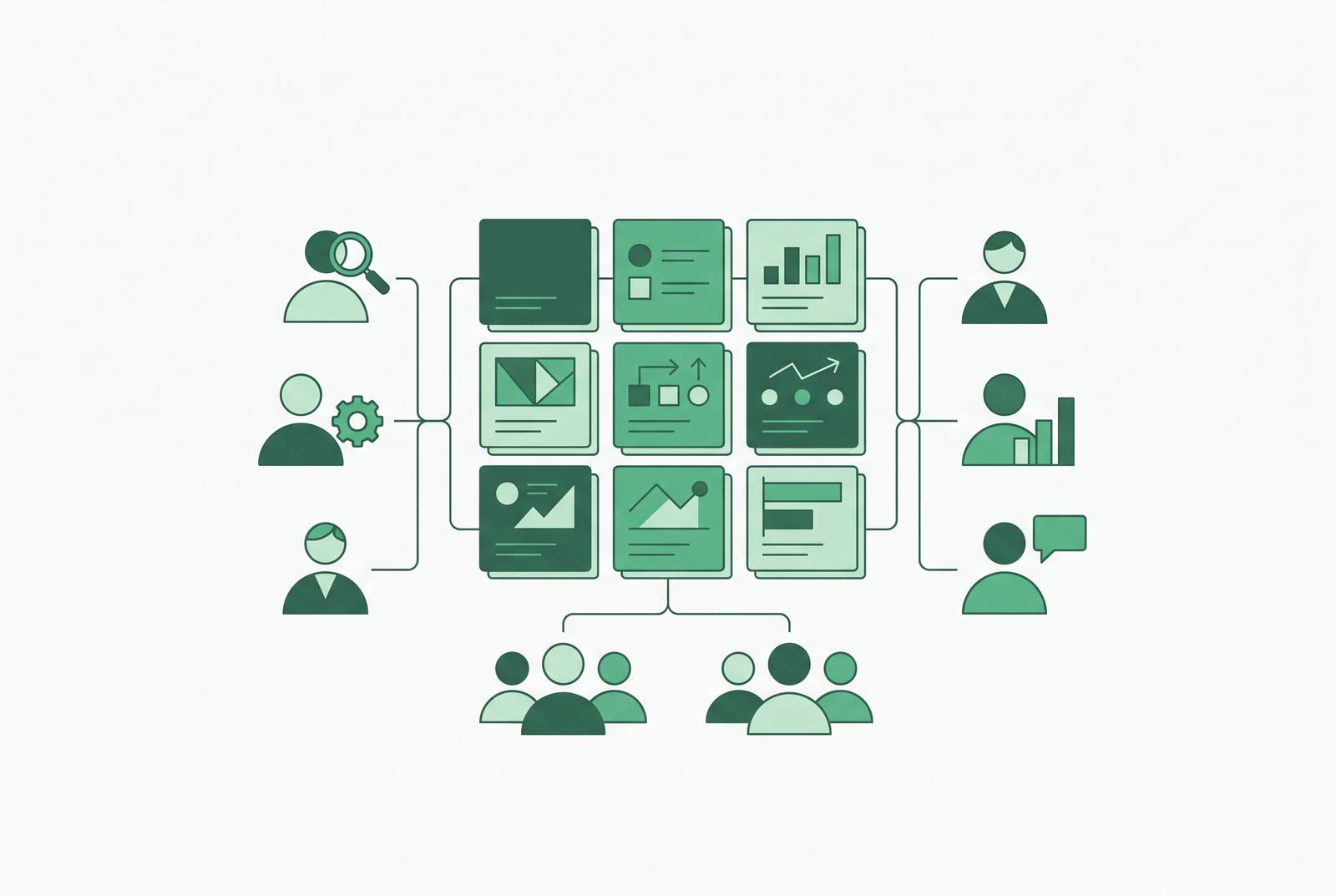
Picture a board meeting where sales presents one revenue number, finance presents another, and product quotes a third. Nobody is lying. Each number is correct, built by whoever assembled it. That's the normal state of most companies with more than a few teams, and it has nothing to do with which dashboard software sits on anyone's laptop.
The root cause is structural. Marketing gets measured on leads, product gets measured on feature velocity, finance gets measured on MRR, and each team builds its metrics to serve its own scoreboard. Revenue, active users, churn: these sound like single, obvious numbers, but they get calculated differently in every system that touches them, because every team has a reason to calculate them its own way.
Adding tooling to the mix multiplies the problem instead of shrinking it. Analytics engineering writes one version of the logic. The BI layer maintains a separate version of that logic. Now AI copilots are writing a third. Change the metric once, and someone has to go find and fix it in three separate places, multiplying the cost of every update.
Data mesh and cross-functional setups make this worse, not better. When every team gets its own slice of ownership, each one ends up re-deriving its own definition of something like "churn," so duplicate metrics pile up. A catalog can exist and still do nothing when the data product underneath it never got a canonical definition attached in the first place.
Cross-functional teams fail most often because of missing governance structure, and per Tabrizi's HBR research, teams with strong governance succeed at a dramatically higher rate than those without it. The same gap that derails project coordination derails metric consistency. Squads get ownership of outcomes, but nobody hands them ownership of metric definitions, so functional standards collapse the moment there's no explicit mechanism holding them together across teams.
Teams often assume the fix is a new tool, buying a BI platform or standing up a data catalog. That assumption misses what actually happens next. A catalog stuffed with competing definitions, several lineage variants for the same table, and four different owners with four different mandates does not build trust. It teaches everyone to stop checking the catalog at all. Once that happens, people go back to pulling numbers from wherever's fastest, and fragmentation wins again.
The metric catalog schema is the load-bearing structure of a semantic layer
A semantic layer is a centralized definition of business metrics, dimensions, and logic that sits between the data warehouse and everything downstream of it: dashboards, AI agents, APIs, notebooks, embedded analytics. Write the logic for "monthly revenue" once, in this layer, and every consumer downstream uses that same logic instead of writing its own version.
The metric catalog schema is what makes that promise real. It's the specification for every field a metric record has to carry: metric name, owner, business definition, calculation logic, grain, permissible filters, data lineage, access tier, and refresh SLA. A namespace, a schema, a workflow, and a set of consumers get much easier to design once a metric has one clear definition attached to it. If teams can't agree on what a metric means, that disagreement carries straight into the catalog, unresolved, when that step is skipped.
This is what separates safe self-serve analytics from dangerous self-serve analytics. Without a governed layer, non-technical users get fast access to wrong answers. With one, they get governed access to consistent answers. Speed was never the missing ingredient. Trust was.
The same logic applies to AI tools querying the data. Most AI analytics failures aren't hallucinations in the sense people usually mean. The model picks the wrong table, joins at the wrong grain, or aggregates something incorrectly. A governed semantic layer catches the majority of those errors before a query ever runs, because the model reads a definition someone already checked instead of guessing at structure. It's reading a definition someone already checked.
Most semantic layer projects fail for a specific, avoidable reason: teams build the layer like it's documentation, something to reference, rather than infrastructure with contracts that get enforced. That's the line between a catalog that actually governs behavior and one that just describes it after the fact. A description nobody has to follow will get ignored the first time it's inconvenient.
The required fields in a well-formed metric catalog schema
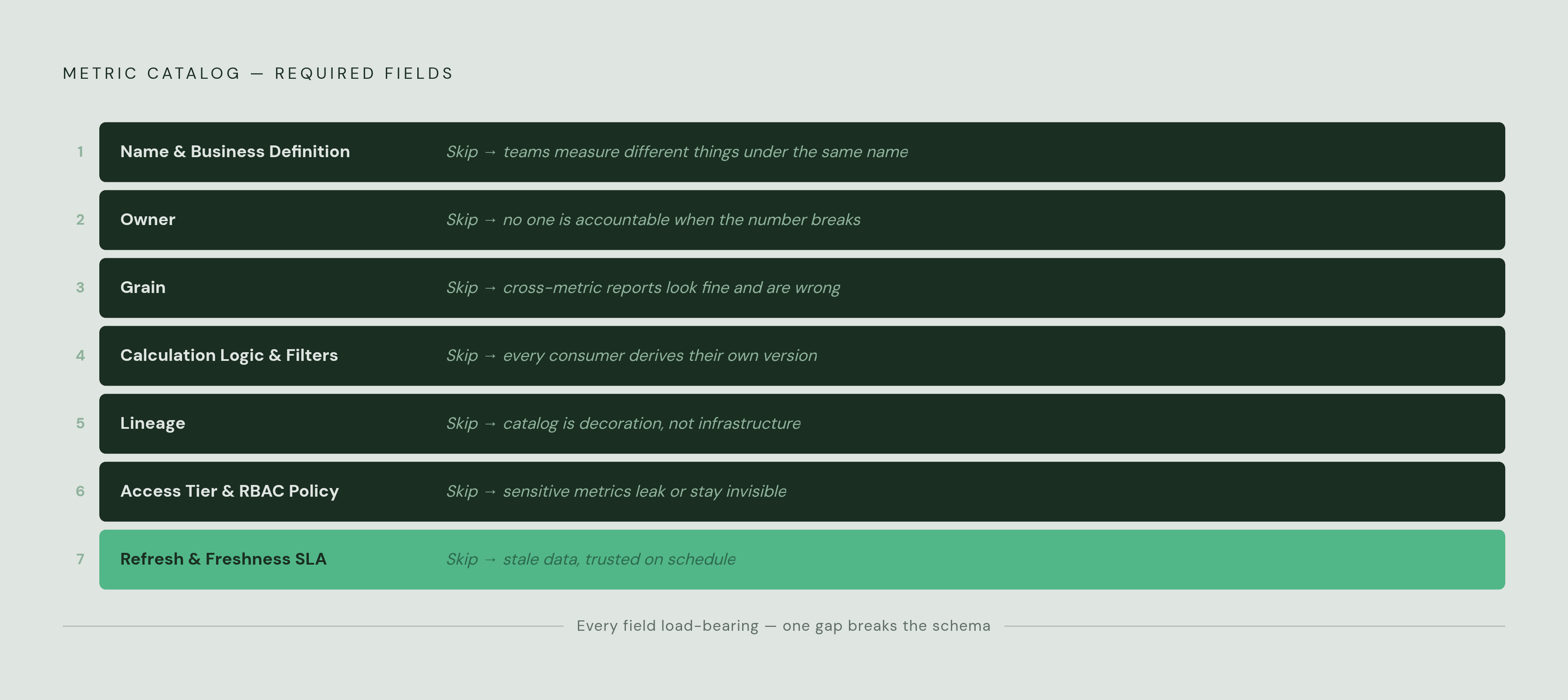
A metric catalog schema is only as strong as its weakest field. Skipping any one of the following fields leads to a predictable failure.
Metric name and business definition. The definition needs to be written in plain language, not SQL, because it's the contract between the data team and every non-technical person who reads it. If the plain-language version is skipped, two teams can look at the same metric name and mean completely different things. The catalog entry looks official. It resolves nothing.
Owner. Assigning an owner to every important metric and published dataset isn't busywork, it's the accountability structure that makes the rest of governance enforceable. For cross-functional teams, the owner needs to be a specific squad or function holding the definition, distinct from whoever happened to build the underlying table. Those are frequently different people, and confusing them is how definitions drift without anyone noticing.
Grain. Grain describes what one row of the underlying data represents, such as a session, a user, or a transaction. If grain isn't declared, the metric can't be safely joined to any other metric. AI agents that skip grain resolution entirely will produce cross-metric reports that look fine and are wrong.
Calculation logic and permissible filters. Calculation logic needs to be stored in a form a machine can run, a specification beyond a paragraph describing the idea. A sentence explaining how churn gets calculated is not a substitute for the actual SQL or metric expression that computes it. Permissible filters set the boundaries on how people can slice the metric, so nobody filters revenue by a dimension that doesn't actually join cleanly at the grain that's been declared.
Lineage. Column-level lineage running from source through the transformation layer through the warehouse through BI is the baseline expectation now. CME Group traced trading-system lineage in days instead of weeks using catalog lineage capabilities, and Tide turned a 50-day GDPR tagging process into a matter of hours. Both results depend on lineage being something a machine can query, recorded as structured metadata rather than written down in a wiki somewhere. Lineage only a human can read functions as decoration rather than infrastructure.
Access tier and RBAC policy. Role-based access control restricts who can see what based on job responsibility, and sensitive fields get protected through masking or tokenization. Databricks Unity Catalog's metric views show the pattern clearly: a metric view is read-only, users need SELECT and the right usage privileges to query it, and by default only the owner can edit its definition, which stops an editor from quietly modifying the view to reach data they shouldn't. Multiple editors is possible, but ownership has to transfer to a group that actually has access to the source tables. The alternative, sharing raw database credentials or handing out SQL-only access, is exactly the failure this field exists to prevent.
Refresh and freshness SLA. Without a declared freshness SLA, nobody looking at the number knows if it's from this morning or last quarter. For teams making day-to-day calls, support, sales, ops, a stale number that looks current does more damage than no number at all, because at least an absent number doesn't get mistaken for truth.
How ownership and namespace design prevent metric sprawl across squads
Well-defined metrics still fork silently as companies grow, and the reason is usually namespace design, not definition quality. A namespace that mirrors the org chart breaks the moment there's a reorg. A two-level structure shaped like domain/metric, with stable domain names like finance, product, or marketing rather than a team lead's name, survives restructuring in a way the org-chart version never does.
This mirrors a pattern familiar from data catalog design more broadly: naming things after the org chart guarantees rework, naming them after stable business domains doesn't. The same logic that keeps a catalog usable across a reorg keeps a metric catalog usable across one too.
Ownership needs the same discipline. Cross-functional squads own outcomes end to end, but functional leaders own the craft standards that cut across teams. Metrics split the same way: the squad that uses a metric day-to-day is not automatically the one that should own its definition. Ownership belongs with the function responsible for the underlying business process. A support team using a churn number didn't necessarily build the business logic behind churn, and shouldn't be the one deciding what it means.
Organizing datasets around departments, and assigning clear owners to every important metric and dataset, is the convention that keeps a finance team and a revenue team from independently building finance/mrr and revenue/monthly_recurring and treating them as two unrelated things. Without functional governance holding squads together, squad-based orgs drift toward inconsistent output by default. Without functional governance, this is how "active user" ends up with five different definitions across five squads, each one defensible in context and none interoperable.
The practical fix: register a metric with the team closest to the business process that produces the underlying data, have a functional owner review it, and version it when the definition changes rather than deleting and rebuilding it from scratch. A metric that quietly changes definition invalidates every dashboard and report already built on it. The schema needs to treat a definition change as a tracked event with its own lineage, not an edit dropped into a wiki page with no trace.
Where the metric definition should live
Defining a metric once and using it everywhere is a real capability, but where that definition actually lives changes what kinds of questions the catalog can answer well. No single location handles every kind of question well in 2026c31.
The central dispute is whether the definition should live in a BI tool's native model, a standalone headless semantic layer, the warehouse itself, or the transformation layer. There's no universal right answer here. It depends on who's reviewing the definitions, which BI or AI tools need to query them, and how much governance the team actually needs.
The transformation layer is one option, with the dbt Semantic Layer (built on MetricFlow) as the leading vendor-neutral example as of 2026. Plenty of teams say "we use dbt" and mean the transformation layer only. The dbt Semantic Layer is a separate thing, built on top of dbt models, that defines, computes, and serves metrics. Its strength is proximity to the transformation logic, which makes lineage from raw source to metric definition feel natural. Its cost is one more layer a team has to maintain on top of everything already running in the warehouse.
Warehouse-native semantic objects are the second option: Databricks Metric Views, which reached general availability in early 2026 after a 2025 announcement, and Snowflake Semantic Views, definable through SQL DDL or a YAML spec, stored as first-class objects right alongside tables and views. Keeping the definition where the data already lives cuts down on the number of systems anyone has to govern. These warehouse-native views handle a metric plus a dimension just fine, but they struggle with cohort analysis, period-over-period comparisons, and cross-grain ratios, the questions business teams ask constantly. Defining metrics once at the warehouse level and consuming them anywhere remains an early-stage promise in 2026, with real limits on expressiveness compared to dedicated semantic layer tools.
LookML is a code-based semantic layer that, once built, gives marketing and sales the same trustworthy metric definitions a data team uses internally, with git-based development branches giving it real modeling maturity. The tradeoff: a definition locked inside one BI tool can't be consumed by AI agents, notebooks, or any other downstream tool without duplicating it, which reintroduces the exact fragmentation the semantic layer was supposed to fix in the first place. Cost matters too. Vendr's data puts average annual spend on this kind of platform well into six figures, worth weighing against the size of the team actually using it.
Standalone catalogs with cross-platform visibility are the fourth option. Atlan was named a Leader in the 2026 Gartner Magic Quadrant for Data & Analytics Governance, and for multi-cloud or hybrid environments, a standalone catalog gives visibility across platforms that a native tool tied to one warehouse simply can't. Atlan's catalog also feeds context to AI agents through MCP, semantic search, and a governed context store, and that catalog is more load-bearing now than in earlier years, because an agent depends on it in the exact moment it's reasoning through a query, not at some later point. Collibra and OvalEdge cover similar standalone-catalog ground for enterprise governance needs.
One warning belongs in every version of this decision: every BI vendor in 2026 can demo an AI chat that answers a simple lookup question, and a single-fact-table question will make almost any modern language model look competent on almost any platform. That demo says little about whether the system underneath can handle the harder questions a business actually asks day to day. The schema design sitting underneath the chat window determines reliability.
None of this is settled. A 2026 industry survey found satisfaction with existing approaches to inconsistent metrics across AI and BI tools remains low; teams are still actively testing different setups rather than converging on one answer. The right call for this architecture choice depends on the stack already in place, the size of the team, and how much governance the organization actually needs to enforce.