Schema Context Window Limits and SQL Accuracy Degradation
Larger context windows hide a sharp accuracy cliff when schemas approach real-world size.
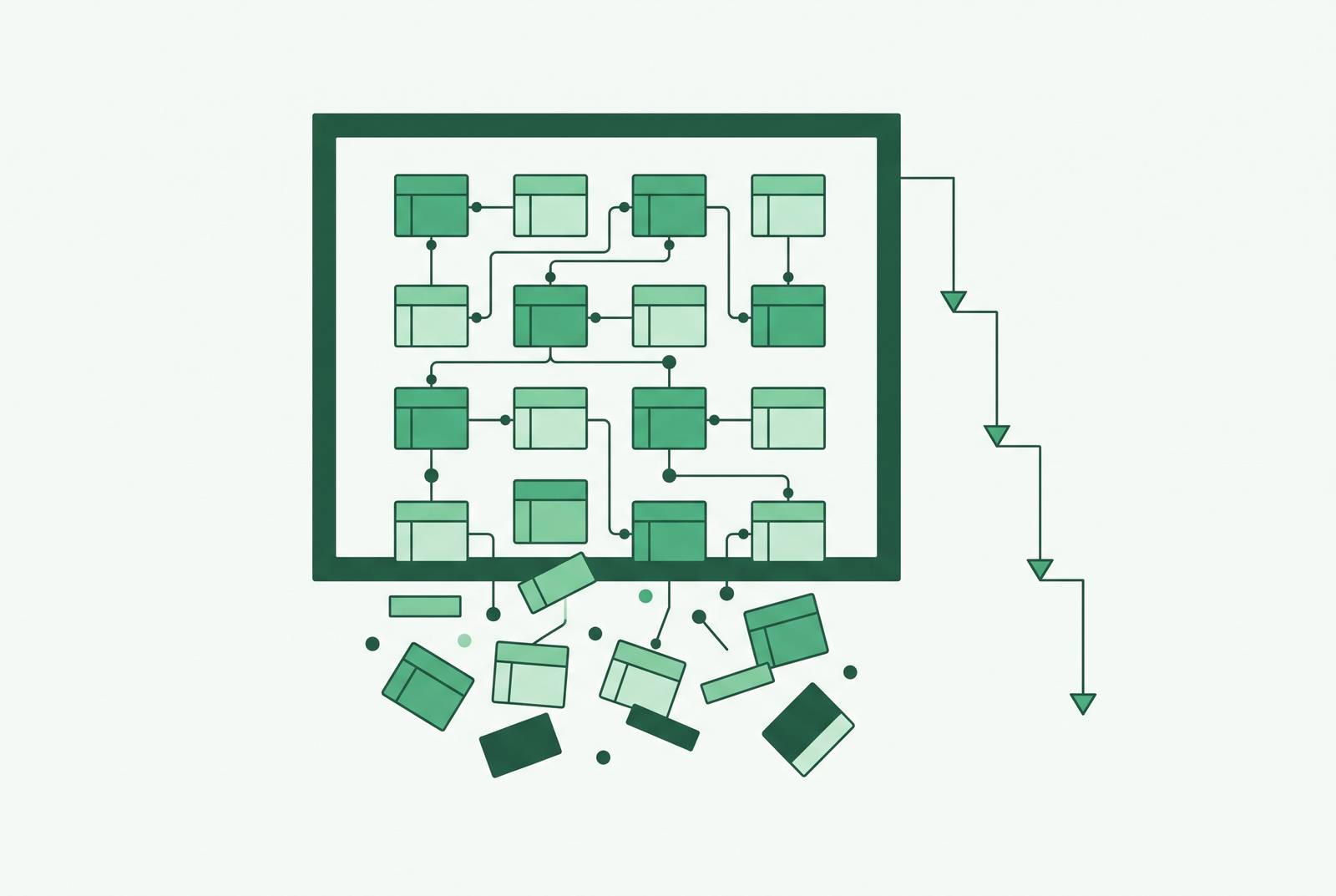
A model that claims a million tokens of context sounds like it can read your entire database schema with room to spare. The research says otherwise. Accuracy starts dropping long before the window fills, and for SQL generation the practical ceiling is low enough to matter on day one.
Why advertised context window sizes mislead teams building AI SQL tools
Vendors publish big numbers. One model advertises a context window in the tens of millions of tokens. Another model lists a million tokens. The message is clear: feed the model as much schema as you want. The architecture can hold it.
What those numbers do not tell you is when the model stops using what it holds. The advertised Maximum Context Window (MCW) is an architectural limit. It says nothing about the point where output quality starts to slide. For teams building AI SQL tools, the gap between those two things is the entire ballgame.
Enterprise schemas are large by nature, not edge cases. A mid-sized production database with dozens of tables, hundreds of columns, and inline descriptions can consume tens of thousands of tokens before you even add the user's question. The schema of a typical enterprise data warehouse does not fit inside the window where a model stays sharp. It fits inside the window where a model is already losing its grip.
The headline number, in other words, is a capacity figure. What you actually need is a performance curve. And that curve bends much earlier than the marketing suggests.
How attention mechanics turn schema size into a quality problem
This is not a prompting problem you can tune away. Context degradation is structural. It comes from how transformer attention handles long inputs, and it shows up in every model the researchers have tested.
Rotary Position Embedding (RoPE) is the main culprit. It introduces long-term decay that deprioritizes tokens far from the current query position. In practice, that means tokens sitting in the middle of a long context lose the most influence. Parse that for a schema prompt: the elements you load early, the tables and columns that describe your data model, end up in exactly the zone where the model pays the least attention.
Andrej Karpathy's framing makes this engineering-legible. The LLM is the CPU. The context window is RAM. And like RAM, it degrades under load. Load more than it can handle reliably and you get failures, not a graceful slowdown. The model does not tell you it lost track of a column definition. It just produces SQL that uses the wrong one. So the fix is not a bigger context window. The fix is understanding that attention has a decay curve, and your schema is sitting on that curve whether you like it or not.
What MECW actually means for a production database schema
Paulsen (2025/2026) put a name on the real limit: Maximum Effective Context Window, or MECW. It is the longest span of token input, for a given problem type, for which incremental tokens degrade the model's output with a measurable effect. The MECW is not a single number. It shifts by task type.
That shift matters enormously for SQL generation. Summarization can tolerate a long, rambling document. Code completion benefits from focused context. Everything after that point is operating inside the degradation zone.
The BEAVER benchmark (MIT/Stonebraker et al., 2024, last revised May 2026) shows what a real enterprise schema looks like. That volume pushes well past the MECW for SQL tasks on most models. The practical ceiling for reliable SQL generation is not the number on the box. For large schemas, you may hit it before the schema finishes loading.
How badly accuracy actually drops as schemas grow — the benchmark evidence
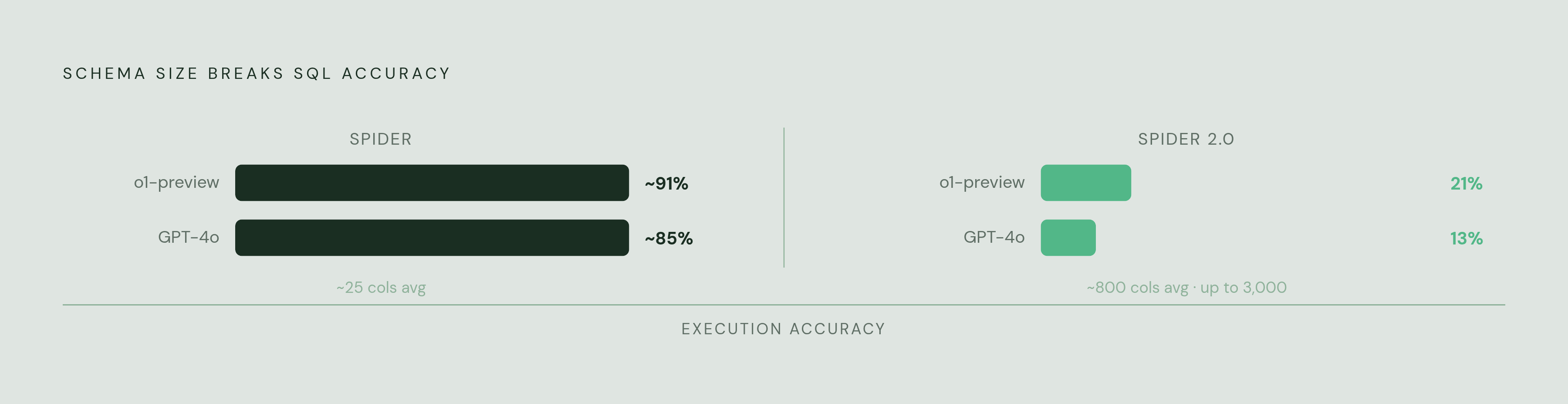
Now the numbers get uncomfortable. The original Spider benchmark made things look easy. Frontier models hit near-perfect execution accuracy on it. Then Spider 2.0 arrived.
Spider 2.0 uses real-world enterprise schemas averaging around 800 columns, with some reaching 3,000. Suddenly the floor drops. The best-performing frontier configuration, Spider-Agent with o1-preview, manages only 21% execution accuracy. GPT-4o scores around 13%. These are not marginal regression errors. These are results that flip from "this tool works" to "you cannot trust this tool" on the same underlying models.
Schema linking errors drive most of the failure. The model does not fail at writing SQL. It fails at figuring out which parts of the schema it should be looking at in the first place.
Chroma's 2025 study of 18 frontier models confirms the pattern is universal. No model was immune. You cannot shop your way out of this by picking a different vendor.
Why schema noise is a distinct problem from context size
Here is the part that surprises people. Even if your schema fits comfortably inside the MECW, irrelevant schema elements still degrade SQL generation on their own. The problem is not just volume. It is noise.
Irrelevant tables and columns occupy attention capacity. They introduce wrong JOIN candidates. They dilute the signal from the columns your query actually needs. And it attends to them anyway, because it has no prior filter to tell it what to ignore.
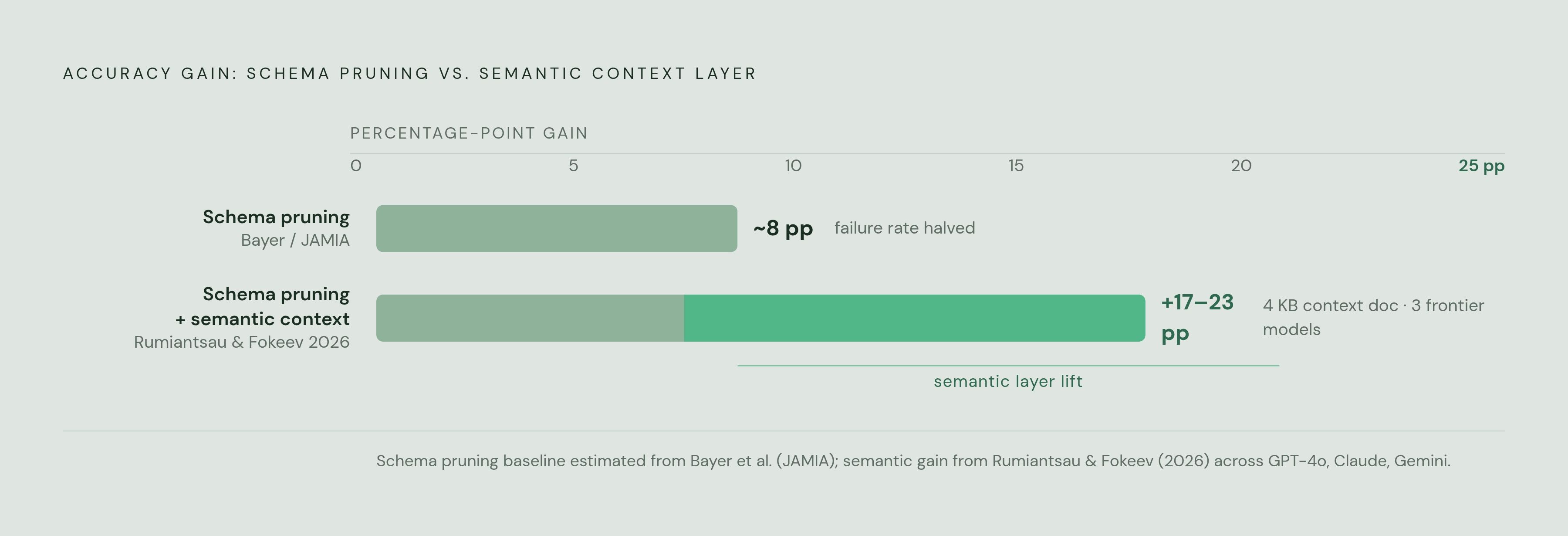
The Bayer/JAMIA Open case (Painter et al., 2024) isolates this problem nicely. On a set of pharmacovigilance queries, narrowing the schema without adding business context reduced the failure rate but left it at roughly half. It could not carry the work on its own.
So there are two problems stacked on top of each other. Context size pushes you past the MECW. Schema noise eats away at accuracy even when you are under it. Fixing one and not the other leaves you with a tool that fails half the time, just for a different reason.
The pruning dilemma: aggressive filtering trades noise for missed recall
The obvious answer is to prune. Give the model only the schema it needs. And pruning does improve accuracy. The Stanford CHESS system, tested on a database with thousands of columns, found that pruning improved accuracy while substantially cutting the tokens sent to the model.
But pruning has its own failure mode. Do it naively and you remove schema elements the model actually needed. You get SQL that is wrong for a different reason: missing joins or missing columns. The noise is gone, but so is the signal.
LinkAlign's result shows what naive minimization costs. Its noise-minimization strategy achieves a low Strict Schema Recall Rate with a small average number of recalled columns. The model produces SQL, sure. It just produces SQL against a schema that no longer contains the pieces it needs.
There is also a model-size dependency here that most teams miss. Exact-match pruning improves accuracy more for smaller models than for larger ones. The optimal pruning strategy is model-size-dependent, not universal. Teams that pick a pruning approach and treat it as solved are probably optimizing for the wrong model.
A competing position, argued in "The Death of Schema Linking?" (2025), says that for schemas small enough to fit within the context window, you can skip schema linking entirely. Augmentation, selection, and correction do the work. Fair enough. But that argument collapses at BEAVER scale, where the schema alone exceeds any practical MECW for SQL tasks. You cannot skip schema linking when the schema does not fit.
Iterative schema expansion as an alternative to one-shot pruning
The research is moving away from the binary. Prune upfront or pass everything. Those are no longer your only options.
AutoLink (AAAI 2026) shows a third path. It achieves state-of-the-art strict schema linking recall on Bird-Dev and Spider-2.0-Lite, with competitive execution accuracy on Bird-Dev. How? By incrementally expanding the candidate schema rather than pruning once at the start. The agent explores. It adds tables and columns as it discovers what it needs. Nothing is committed upfront, and nothing is assumed irrelevant forever.
LitE-SQL points in a similar direction from a different angle. It achieves strong execution accuracy on BIRD and Spider 1.0 using a lightweight schema linker with far fewer parameters than LLM-based methods. The schema linking step itself can be efficient, cheap, and privacy-friendly. You do not need a large-context inference call just to figure out which columns matter.
The common thread: multiple small, targeted schema retrievals beat one large noisy one. The one-shot full-schema call is not the only architecture. It is increasingly not even the default.
What semantic layers actually fix — and what they don't
Schema engineering is only half the problem. The other half is context quality, and that is where semantic layers earn their keep. Supplying explicit business semantics alongside the schema changes what you are asking the model to do, not just how much it has to read. The distinction produces large, consistent accuracy gains across models and datasets.
The Bayer/JAMIA Open result establishes the magnitude. GPT-4 on pharmacovigilance queries goes from very low accuracy with schema alone to strong accuracy when you add a business-context document. Schema reduction alone left the failure rate at roughly half. The semantic document is what moves the needle.
Rumiantsau & Fokeev (2026) confirm this with a paired benchmark over a retail dataset in ClickHouse. Three frontier models, tested with and without a 4 KB markdown document describing the measures, conventions, and disambiguation rules. Adding the document improves accuracy by 17 to 23 percentage points across all three models. The presence of the document accounts for essentially all of the significant variance. Model choice within tier does not.
The dbt Labs benchmark (Ganz & Perigaud, April 2026) finds the same thing. GPT-5.3-Codex moves from strong text-to-SQL accuracy to near-perfect on the semantic layer condition. Snowflake Cortex Analyst, with a semantic model, reports roughly twice the accuracy of single-shot GPT-4o without one.
The mechanism is not magic. Semantic layers supply what the schema does not encode: measure definitions, aggregation conventions, join paths, disambiguation rules. The model does not have to infer these from table and column names while fighting attention decay. It gets them as explicit context.
But here is the governance risk that deserves your attention. The failure type changes, not just the rate. Semantic-layer failures tend to be refusals. The model says it cannot answer. For a non-technical user looking at a dashboard, that is the difference between a visible gap and an invisible one. The refusal gets noticed. The wrong number gets acted on.
Why this is a governance and tooling problem, not just a model selection problem
Expanding the context window does not solve context rot. It does not disappear past it. A multi-million token window just gives you more room to be confidently wrong.
The research consensus points somewhere else entirely. Active metadata governance. RAG, semantic layers, schema filtering, context engineering. That is the path to reliable SQL generation on production databases. Not waiting for the next vendor announcement.
Context engineering is Karpathy's term for "the delicate art and science of filling the context window with just the right information for the next step." That is now the operative discipline. It is to pass the right schema slice for each query.
Teams deploying AI-assisted querying need schema filtering, semantic metadata governance, and permissioned access control as first-class engineering concerns. The tools that hook directly into a production database and route natural-language questions through the full schema without filtering are implicitly accepting all the accuracy degradation documented above. Tools that enforce schema scoping by role and question type are doing context engineering by design.
Consider a team at a roughly 100-person company that wants non-technical colleagues in product, sales, or marketing to self-serve answers from a production database. The silent-hallucination failure mode is the central risk. Governed, schema-scoped access, where each user sees only the tables and columns relevant to their role, reduces both the noise in the context and the blast radius of a wrong answer.
What teams should actually do: schema scoping, metadata governance, and measuring their own MECW
Treat your own production schema as the test environment. Do not defer to benchmark results from Spider or BIRD. Enterprise schema complexity breaks the assumptions those benchmarks were built on. Your database is the one that matters.
Start by measuring your own MECW. Run paired tests with progressively larger schema slices against your own query patterns. Paulsen's (2025/2026) methodology gives you a replicable way to find the degradation point for a given task type on a given model. Do not guess. Measure.
When you prune, use a method with documented recall. The RSL-SQL result, high recall alongside large column reduction, sets a reasonable target. If you cannot show that your pruning preserves the schema elements your queries need, you are trading one failure mode for another.
Invest in semantic metadata. The consistent finding across Bayer, Cube, dbt Labs, and Snowflake is that authoritative business context produces large accuracy gains independent of model choice. A 4 KB markdown document that defines your key metrics is more valuable than switching to the next frontier model. Write it. It will outlast whatever model you are on.
Scope schema access by role and question type. Do not pass the full schema on every call. Everyone gets less noise, and the blast radius of a wrong answer shrinks.
Watch for the silent hallucination specifically. Build in result validation or anomaly flagging for dashboards used by non-technical teams. You will not know it happened unless you look for it.
Finally, treat schema linker choice as model-size-dependent. Exact-match pruning benefits smaller models more than larger ones. For larger models, iterative schema expansion approaches like AutoLink are likely to outperform static pruning. Match the method to the model, not the other way around.
The lasting takeaway is not about tooling. Schema context is an engineering discipline your team must own. No vendor will ship it pre-solved. The governance framing, who can see what, which semantics are authoritative, how you measure degradation, is where reliability comes from. That work is yours.