Evaluating AI Analyst Tools on Metric Definition Compliance
Architecture determines whether AI analyst tools enforce certified metrics or invent them.

Evaluating AI analyst tools on metric definition compliance starts with a question less glamorous than “How clever is the model?” Where does it get its business logic? The strongest predictor of a compliant answer is whether the tool queries a governed semantic layer or invents SQL against raw tables. The architecture sets whether the tool must follow approved definitions or can treat them as advice.
Why architecture is the right lens for evaluating AI analyst tools on metric compliance
An AI analyst gives back a polished table that explains why churn rose. The answer looks ready for a board pack, but its SQL uses a flawed join or quietly rebuilds churn from a different definition. The tool has supplied confidence where it needed a constraint.
That is why feature lists, demo performance, and benchmark scores are poor substitutes for examining the query path. A clean demo question with an obvious answer leaves little room for architectural differences to show. Vague questions against tables with subtle joins expose them. The useful distinction is not whether a tool can answer in plain language, but what prevents it from choosing the wrong business logic.
What metric definition compliance actually requires from a tool
Metric definition compliance means an answer comes from the organization’s certified business logic, and the user can verify that from the answer itself. Plausibility is not enough to pass the test. Finance might base its definition of churn on revenue loss, marketing on subscription cancellations, and customer success on net retention. Each calculation can be internally correct while answering a different question. AI placed over that fragmentation gives inconsistency a faster delivery service.
A compliant tool must meet three conditions together. It queries a governed metric rather than re-deriving business logic from raw columns. It enforces row-level and role-based access before the query runs, rather than filtering away forbidden results afterward. Its answer also exposes enough lineage, including the metric, filters, and query, to reproduce the number. The testable standard is therefore a question whose answer depends on both a certified definition and a user’s access rights, followed by a trace of how that answer was produced.
The five ways a compliant-looking AI answer can be wrong
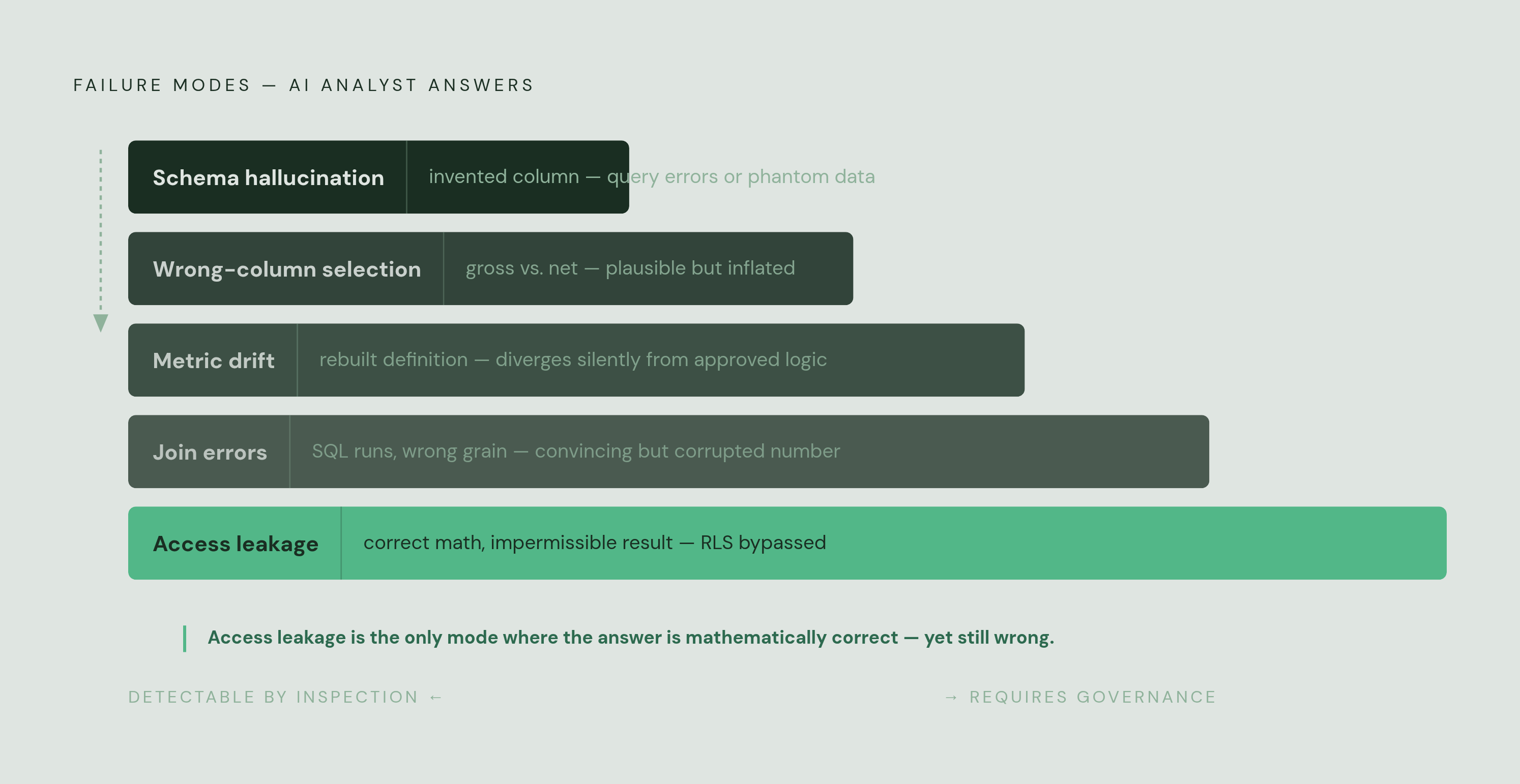
Schema hallucination is the first failure mode. The model invents a table or column, and the query usually fails because the identifier does not exist. That visible failure is comparatively helpful. An invented identifier that happens to match a real column can instead produce a silent error.
Wrong-column selection is the quieter cousin of hallucination. The model chooses gross_revenue when the metric requires net_revenue. Both columns exist, so the warehouse has no reason to object. Successful execution does not establish business correctness.
Metric drift occurs when the AI rebuilds a business number using logic that differs from its approved definition. A raw-table query path leaves that choice open on every question.
Join errors happen when tables are joined in the wrong way to produce an answer. The SQL may run and return a convincing number even though the relationships or grain are wrong.
Access leakage means the user receives data they should not see because the query bypasses row-level security. A correct calculation can still be an impermissible answer.
How a semantic layer prevents each failure mode — and what it actually is
A semantic layer sits between raw tables and the AI agent. It defines exact, versioned and certified metric logic, approved join paths and grain, dimensions and synonyms, and access policies. The agent selects the business calculation from this model. That constraint changes the job the model performs.
Governed measures and dimensions constrain schema and column selection, while synonyms connect ordinary phrasing to those definitions. Approved join paths address relationship errors. Selecting a certified churn metric prevents the agent from re-deriving churn for any query that stays within the layer. Row-level and role-based policies apply before SQL reaches the warehouse, closing the permission gap.
The same selection process supports answer traceability because the agent can show which metric and filters it used. A semantic layer’s protections depend on correctly modeled definitions, joins, and permissions, with some data quality problems remaining unresolved. Those definitions must exist before the AI can answer through them, which makes upfront modeling a real engineering commitment.
The strongest objection to requiring a semantic layer — and why it doesn't resolve the compliance problem
Does that commitment defeat the point of self-service AI? Building a governed model takes engineering time, while the sales promise is that a team can ask questions without waiting for engineering. Requiring weeks of preparation before the first useful answer can make the shortcut look suspiciously like the long way round.
For one-off exploration by a skilled analyst who will inspect the SQL, text-to-SQL over raw tables is a reasonable choice. The analyst supplies the review the architecture does not. The tradeoff changes when answers go straight to business users who cannot spot a wrong join, or feed board packs and customer-facing analytics.
Could a stronger reasoning model close the gap? Yin et al.’s ACL 2026 research, “The Reasoning Trap: How Enhancing LLM Reasoning Amplifies Tool Hallucination”, challenges the assumption that more reasoning reliably reduces hallucination. A more capable model can produce more correct claims and more wrong ones per response. Better reasoning therefore does not replace a binding definition or an enforced access rule.
How different semantic layer architectures handle compliance — five deployment patterns
For organizations with an established BI stack but inconsistent definitions, a governance-layer pattern fits above and around existing tools. It adds certification, lineage, and catalog integration without replacing the warehouse or BI platforms. The focus is coordination rather than wholesale replacement. Its fit depends on whether existing tools can work within that governed perimeter.
For teams centered on their warehouse, warehouse-native definitions place metrics inside the existing role and grant model. Snowflake Semantic Views reached SQL-query general availability March 2026, while Databricks Metric Views reached GA April 2026. Snowflake defines metrics with CREATE SEMANTIC VIEW DDL and supports SQL, natural language through Cortex, and standard BI connectors, with inherited RBAC and row-level security. Databricks Genie can resolve questions against Metric View definitions, while AI/BI dashboards query those same definitions. Genie also supports raw tables and views, so the available governed path does not by itself prove that every answer uses it.
For organizations serving several BI surfaces, a headless or universal layer provides a standalone service that agents, dashboards, embedded analytics, and APIs can query. Cube Core is an open-source example of this pattern. It lets different consumers use the same definitions. The model does not have to belong to any one interface.
For teams whose analytics stay within one BI platform, a BI-native layer keeps dashboards and AI answers on the same model. The tradeoff is portability. A second BI tool or a dbt workflow can require metrics to be maintained in two systems, creating a governance tax that grows with the metric set.
For teams already organizing metric work through dbt, a dbt-centered pattern fits that development workflow. The dbt Semantic Layer defines metrics in version-controlled YAML files beside the models. Its documentation describes both co-location and a parallel subfolder under models/semantic_models/, and recommends the subfolder for teams that cannot decide. This places definition maintenance within the modeling workflow rather than inside a BI interface.
What the metric promotion loop adds — and why most tools don't have it
A semantic layer can still become a bottleneck. New business questions produce new derived metrics, while most governed AI tools treat the layer as a read-only constraint. If every useful derivation must be hand-coded by a data engineer, answering a new question does not automatically make the next question easier.
A metric promotion loop lets AI-generated metrics be reviewed and promoted into the governed layer. Only a small subset of tools offers this capability. Holistics AI’s AQL approach reuses definitions the team has already established rather than reinventing business logic, allowing AI work to build on shared knowledge. Without promotion or manual modeling, repeatedly re-derived metrics can reintroduce drift inside a nominally governed system.
MCP and the emerging question of where governance lives when agents are external
The same distinction follows the query when the agent sits outside the analytics platform. Model Context Protocol, or MCP, lets agents such as Claude or Codex connect to tools and context made available to them. Cube provides a hosted MCP server using HTTPS with OAuth. An external agent can therefore consume governed metrics without relying on the platform’s own chat interface.
But which of the five failures does MCP prevent? By itself, none of them is resolved merely by changing the connection protocol. A governed connection needs certified measures, dimensions, joins, descriptions, and access rules. With raw warehouse access, the same mistakes as with a direct connection can still occur in schema choices, column selection, metric derivation, and joins. Authentication alone does not establish definition compliance.
The evaluation should therefore ask what the server exposes and whose permissions each tool uses. Every tool should run as the authenticated user and follow the rules for roles, deployment access, and row-level security. Writes that have consequences need to be reviewed, destructive tools need confirmation, and model edits should stay on a development branch for a person to review.
How to run the grounded-answer test before committing to a tool
To turn these architectural distinctions into a buying test, use the organization’s own warehouse. The test involves asking a question whose correct answer depends on a certified metric and a row-level access rule, then tracing the result. The query should use the approved definition. The answer should contain only data the querying user may see, with the metric, filters, and query visible enough to reproduce the number independently.
Raw-table SQL with no reference to a governed definition fails the foundation test, even if the number looks sensible. Run the question as two users whose access rules should let them see different data. An identical result is a leakage warning in that setup. Ask for the metric three different ways as well, since different numbers for equivalent requests expose drift.
The trial should test seven criteria in all. Governed metric foundation, answer traceability, and permission safety test whether the result can be trusted. Business-user Q&A tests whether non-analysts can get useful answers without tickets, while analyst acceleration tests whether skilled users can build, review, and iterate faster. Embedded readiness tests whether the same governed model can safely be used for customer-facing analytics. Modeling investment establishes how much preparation trustworthy answers require, so speed is assessed with its prerequisites included.
What the architecture decision means for data and engineering teams at different maturity levels
For teams with an existing governed semantic layer, the evaluation is primarily about integration quality. The AI should query that layer, and an MCP connection should expose governed context. A promotion loop adds a separate question about maintaining new knowledge. Possessing a semantic layer and using it are different things.
For teams with partial governance, source selection becomes especially important. When certified metrics and raw tables are both available, the evaluation should explicitly test which source the AI prefers. A confident answer cannot reveal that choice by itself. For teams without a semantic layer, the recommendation is to define metrics before deploying AI that answers business questions about them. Analyst-reviewed exploration remains a different use case.
Compliance has a cost under every architecture. With raw-table generation, teams pay for checking each query again and again, while a semantic layer shifts that cost toward modeling each governed definition once and then keeping it up to date as the business changes.