Immutable Query Logs as an Analytical Audit Trail
Cryptographic proof makes audit logs impossible to fake or alter after the fact.
A query log is easy to fake. An immutable one isn't. That's the whole difference, and it's the difference regulators, auditors, and security teams now spend real money to enforce.
Most companies have some version of a query log already: a table somewhere that records who ran what, when. That's a record of what happened. An audit trail is something stricter. It's a record that can be proven, after the fact, not to have been rewritten. Those sound like the same thing until someone with admin rights needs to delete a row, and the question becomes: can they?
That's not a hypothetical. AesirX ComplianceOne has written about a bank incident in Ho Chi Minh City where the real question investigators asked wasn't "do you have logs?" It was: can you prove nothing was removed, edited, or put together after the fact to look clean? Most systems can't answer that. A log stored in a normal database table can be edited by anyone with write access to that table. If your proof of what happened lives in the same system a bad actor controls, it isn't proof. It's a story that system is telling about itself.
So what actually makes an audit trail trustworthy? Three properties, according to AesirX's framing, and all three have to hold at once:
- Append-only behavior. The system only lets you add new rows. No edits, no deletes, not even for admins.
- External anchoring. The record's integrity can be checked from outside the platform that created it. Without this, "append-only" is just a claim the platform makes about itself.
- Verifiability. The record has to hold up somewhere adversarial: an audit, a lawsuit, a breach investigation, a regulator's request.
Standard database logging tools, file-based logs, writable audit tables, usually satisfy none of these fully. A privileged administrator can still touch them. That gap, between "we log everything" and "we can prove the log wasn't touched," is exactly what immutability is built to close. The rest of this piece is about how to close it.
What a query log entry must capture to be useful
A timestamp and a username aren't enough. A log entry that's actually useful for an investigation needs to answer a full set of questions at once, not just one of them.
A reference schema from the technical design community lays out the minimum fields:
- Who did it. Actor type, actor ID, IP address, user agent.
- What kind of action. Read, write, or schema change, each treated differently.
- What exactly was touched. Not "accessed the database," but the schema, table, index, column, or collection involved.
- Before and after. For any write, a snapshot of the old value and the new value.
- Metadata. Precise timestamps, sequence numbers, and how long the request took.
Bytebase's audit log documentation shows what this looks like filled in, and the level of detail is the point. One example entry shows a user, alice@example.com, running the method /bytebase.v1.SQLService/Query, with the exact SQL captured: SELECT email, plan FROM users WHERE id = 12345. The log shows one row returned, the email column masked by a "Range Mask" rule triggered by a global PII protection policy, latency under 20 milliseconds, and the caller's IP address, 10.0.5.42.
Every one of those fields answers a different question an investigator will eventually ask. Who ran this? What did they actually see, not just what did they ask for? Was sensitive data masked or exposed? How fast did it run, and does that match expected behavior? Drop any one field and the trail gets weaker in a specific, predictable way.
This matters even more once natural-language query tools enter the picture. When someone types a question in an everyday language and a software layer turns it into SQL behind the scenes, the user never sees the actual statement that ran. The query log becomes the only record of what really executed against the database. If that log is incomplete, there's no way to check whether the AI's translation was accurate, safe, or even legal.
One more practical note from the reference schema: partitioning the audit table by month. That's not just for tidiness. It makes range queries (find everything from March) fast, and it makes retention policy enforceable, since you can drop or archive whole partitions cleanly instead of hunting for individual expired rows.
The cryptographic layer that turns a log into tamper-evident proof
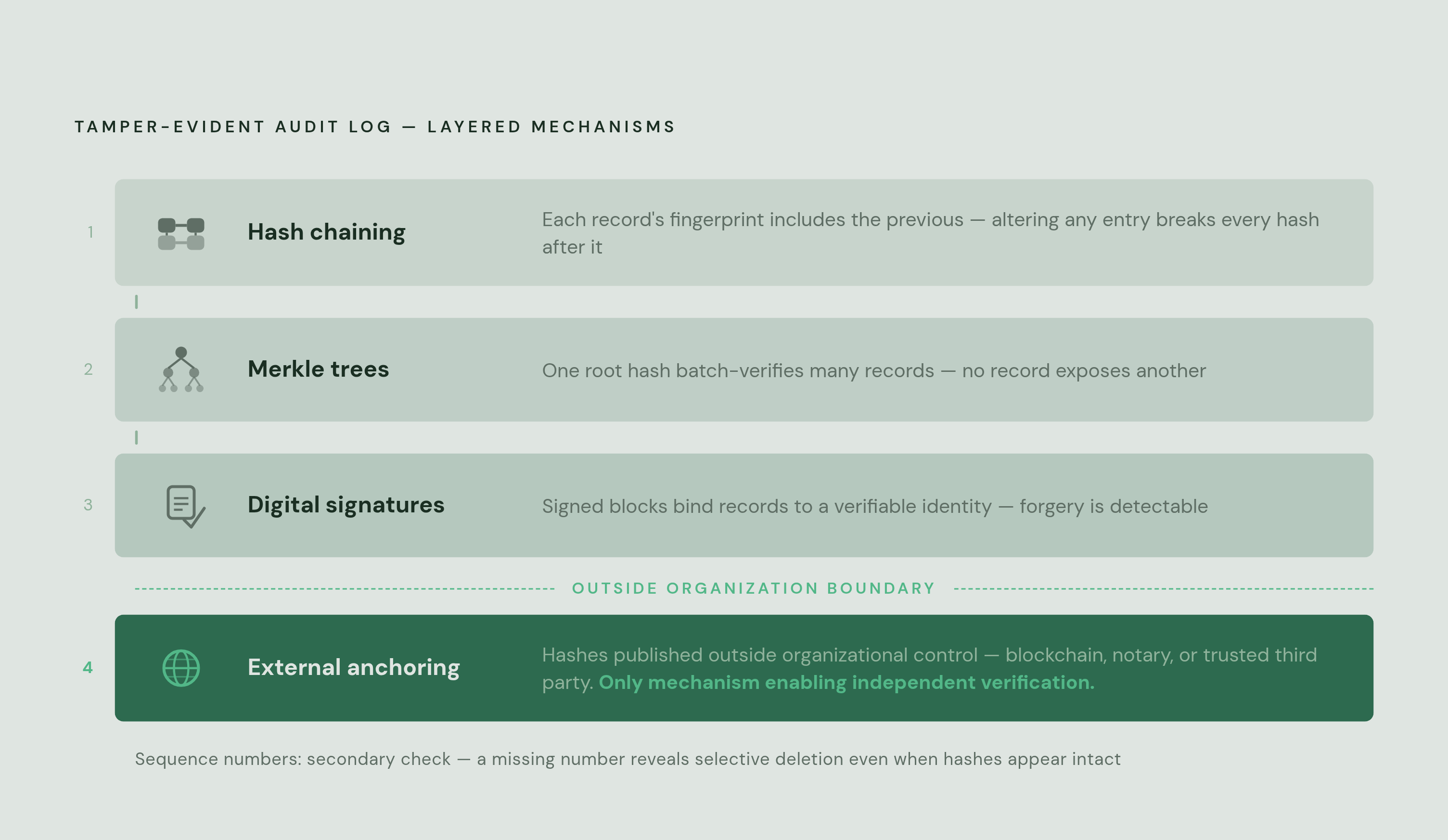
Append-only rules enforced by an application are a good start. They're not the answer. If a database administrator has direct access to the underlying storage, application-level rules don't stop them from editing or deleting a record by hand. The log needs a layer of protection that doesn't depend on anyone's good behavior.
That's what cryptography is for here. A survey of audit trail architectures points to four mechanisms that, combined, close this gap:
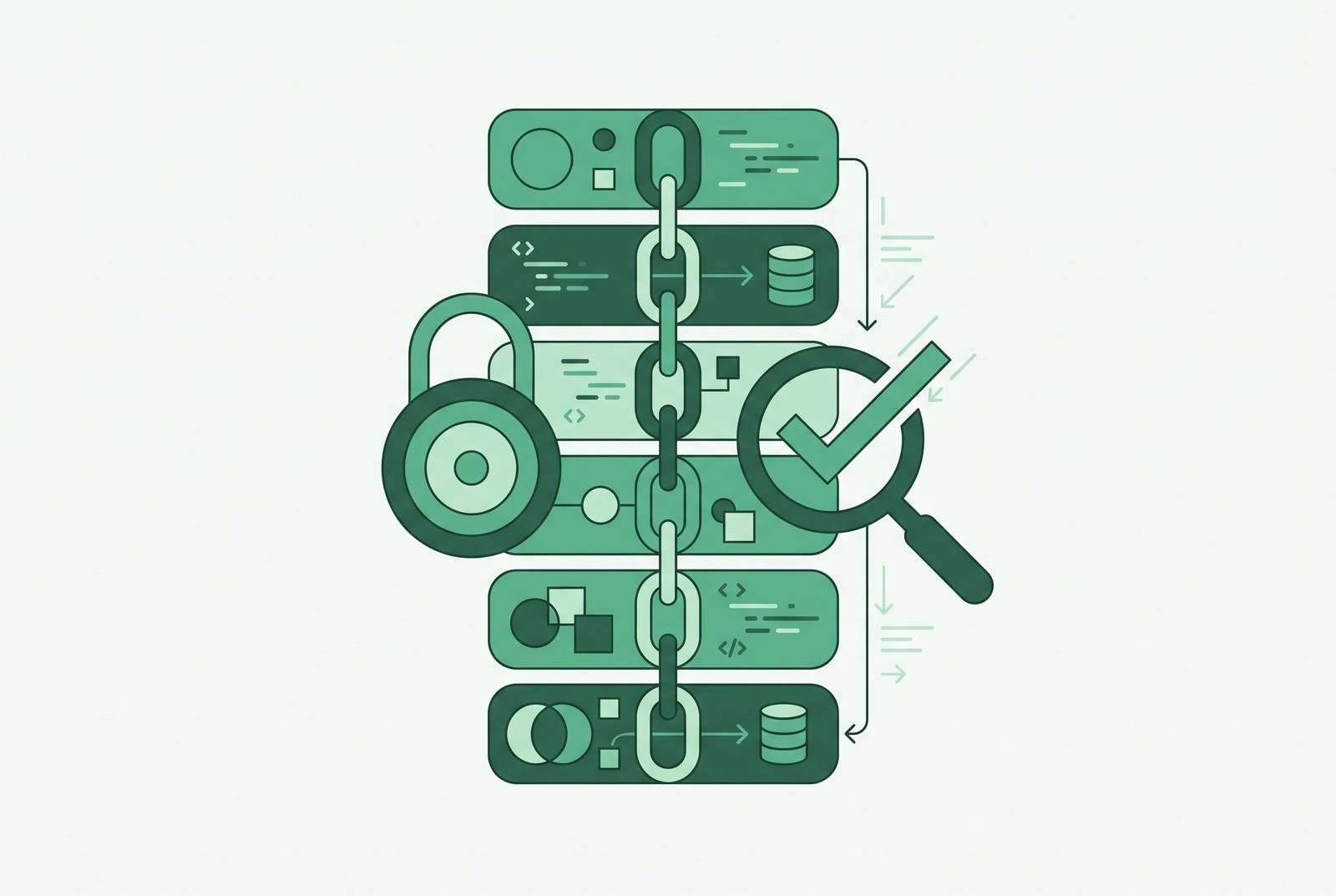
- Hash chaining. Every new record includes a digest (a fingerprint) of the record before it. Change anything in an old entry, and every hash after it breaks. Tampering becomes detectable, not just discouraged.
- Merkle trees. A way to batch-verify large numbers of records. A single "root" hash can prove a specific entry was included in the set, without exposing every other entry in that set.
- Digital signatures. Signed blocks prevent someone from forging new entries and tie every record to a specific, verifiable identity.
- External anchoring. Publishing hashes or proofs somewhere outside the organization's control, a blockchain, a notarization service, a trusted third party, means the record can be checked by someone who has no reason to help cover anything up.
Sequence numbers add a simpler but important check: if hashes are intact but a number is missing, something got deleted. That catches selective deletion even when the hash chain around the gap still looks fine on its own.
None of this replaces solid storage. Write-once, read-many (WORM) storage, AWS S3 Object Lock in WORM mode is one common example, enforces at the storage layer that records can't be overwritten or deleted before a set retention period ends. That's a control independent of whatever the application promises to do, which is exactly why regulators like it.
Put it together and here's the payoff: when an auditor or opposing counsel in a lawsuit asks whether a log could have been assembled after the fact to look clean, cryptographic anchoring with outside verification is what lets the answer be yes, provably, not just confidently.
Why regulations in 2026 treat immutable query logs as mandatory, not optional
This isn't a nice-to-have anymore. Across nearly every regulatory framework that touches data, immutable logging has moved from best practice to hard requirement.
- HIPAA requires mechanisms that guarantee the integrity and immutability of audit logs. WORM storage, digital signatures, or hashing all satisfy this. Minimum retention is six years, longer if state law or internal policy demands it, according to Kiteworks.
- FINRA and SEC Rule 17a-4 are more prescriptive still: records must sit in a non-rewriteable, non-erasable format, be indexed so they can be located, be retrievable quickly, and be handed over to regulators on request.
- SOC 2 auditors have shifted from quarterly spot checks toward continuous monitoring. Logs now need precise timestamps, unique identifiers, and cryptographic hashes. One upside: logs built to satisfy SOC 2 can often double as evidence for ISO 27001, HIPAA, or GDPR.
- SOX requires immutable audit trails for financial reporting workflows. Auditors check specifically whether BI tools log who accessed what data, through which query, when, and from which IP address.
- The EU AI Act adds a wrinkle for high-risk AI systems: Article 26(6) sets a minimum six-month retention requirement for automatically generated logs under the deployer's control.
None of this is theoretical enforcement. Regulators have closed investigations with real financial penalties tied specifically to failures in risk analysis and audit practices. GDPR fines reached €1.2 billion in 2025, and more than 60% of the total penalties issued under GDPR have come since January 2023, a sign the enforcement curve is bending upward, not flattening. On the cost side, the average healthcare data breach runs around $7 million once notification, credit monitoring, legal defense, and regulatory fines (which can hit $50,000 per violation) are added up.
There's a forward-looking signal worth sitting with too. Gartner projected in May 2026 that 40% of enterprises will demote or decommission autonomous AI agents by 2027, because governance gaps only get discovered after something goes wrong in production. Query logging is the foundation that governance policy is built on, and without it a policy can't actually be enforced, only written down. A policy nobody can check is a policy in name only.
How self-serve analytics expands the audit surface area and why that changes the stakes
Every time a company hands data access to a new person who isn't a data engineer, the difficulty of auditing who accessed what gets a little bigger. That's the tradeoff behind self-serve analytics: broader access, broader surface to watch.
Research into self-serve analytics failures points at something specific: most of these failures are governance failures, not access failures. Two people ask the same question and get two different numbers, not because the tool is broken, but because no one enforced a single definition of the metric in the first place. Multiply that by a hundred self-serve users and the inconsistency compounds fast.
Natural language query tools make the problem sharper. A Dresner Advisory study found natural language analytics made real gains year over year in BI adoption, with data security, data quality, and reporting ranked among the top BI initiatives. But NLQ tools generate SQL behind the scenes. The user asks a question in plain language and never sees the query that actually ran. That means the query log isn't just a nice audit feature anymore, it's the only place anyone can go to check what really happened.
A few design implications follow directly from this:
- Row-level security, column masking, and query logging need to apply automatically to every query, not get configured user by user. That doesn't scale once hundreds of people are querying.
- Metric certification, marking specific calculations as the approved, correct version, paired with query logging lets a team check two things at once: what did someone ask, and was the answer built on a governed definition or a rogue one?
- Any AI layer generating queries inside a BI tool should be judged on whether it works from governed business logic, respects existing permissions, and produces something auditable, not just on whether it has "AI" in the feature list.
Broad access without a matching audit trail leaves a company unable to reconstruct what any given user actually saw or acted on. That's not just a compliance headache. It's a genuine blind spot the moment something goes wrong.
Architecting an immutable query log: storage, retention, and verification decisions
Building one of these systems comes down to decisions at three layers, each with real tradeoffs.
Capture layer. Where does the log actually originate? Options include engine-native auditing built into the database itself (SQL Server Audit, PostgreSQL audit extensions), interception at the application layer, or a dedicated database governance platform that sits between users and the database and watches everything pass through.
Storage layer. This is where WORM object storage, AWS S3 Object Lock is the common example, earns its keep, keeping records tamper-evident and encrypted at rest. Append-only tables partitioned by month keep both query performance and retention enforcement manageable.
Verification layer. Cryptographic hash chaining at the moment of write, sequence numbers to catch gaps, periodic export of hash roots to something outside the organization's control, and the ability to export the whole thing to a SIEM platform like Splunk, Datadog, or Microsoft Sentinel for centralized monitoring.
Microsoft's documentation on Fabric Data Warehouse is a useful real-world example of these tradeoffs in practice. SQL audit logs land in OneLake, which encrypts everything at rest by default, and get written as .XEL files in the warehouse's Audit folder. Predicate filtering lets teams cut down noise from automated identities and scheduled jobs while keeping compliance-relevant logging intact. For Fabric Data Warehouse, this auditing is off by default and has to be turned on manually. (Fabric SQL Database auditing is meant to ship on by default for new databases.) A powerful logging system that nobody switches on isn't a logging system, it's a missed setting.
Some platforms push the audit surface further, expanding coverage to account for automated queries becoming a normal part of database traffic.
High-volume systems create their own problem: too much log data. Predicate filtering, sampling low-risk repeated actions, and tiered retention (fast storage for recent data, cheaper cold storage for the archive) are the practical answers. The goal isn't logging every single heartbeat query with equal weight. It's making sure nothing about a high-risk action ever goes missing.
On retention, the simplest rule tends to be the safest: set the retention window at the strictest number required across every framework that applies. Six years satisfies HIPAA, and setting that as the floor is a practical starting point for meeting other frameworks as well. Document the decision and who owns it, because "we assumed six years was fine" is not an answer an auditor wants to hear a year after the fact.
And build export pipelines early. A log that can't be exported cleanly is a single point of failure waiting for the worst possible moment, an audit or a breach investigation, to reveal itself.
Tools and platforms that implement immutable query logging in practice
A handful of tools show the different ways these principles get built in practice, each solving the problem from a different layer.
immudb, an open-source immutable database from Codenotary, released version 1.11 on May 5, 2026. Its approach keeps audit logging built into the database itself rather than shipping logs off to a separate system. Cryptographic verification makes both the data and its change history tamper-evident. Version 1.11 expanded PostgreSQL compatibility, so existing tools and applications can connect to it with minimal changes while gaining tamper-proof records underneath. Codenotary reports more than 50 million downloads and use across many thousands of organizations, with cited use cases spanning financial systems, incident response, regulated industries, AI and automation systems, and supply chain tracking. Codenotary's CTO, Dennis Zimmer, said the core problem is that most systems rely on separate logging tools to track changes, and those logs "can be incomplete, disconnected, or even altered."
Bytebase takes the application-layer interception route. It's a governance platform that sits between users (and AI agents) and the databases they touch, capturing every query, schema change, and permission change along with real user identity, request metadata, and latency. Logs can be searched with CEL filters and exported, and the full change history doubles as a compliance audit trail on its own. A just-in-time access feature lets engineers request temporary elevated permissions, and those access grants get logged the same way everything else does.
Immuta works from the access-governance side. In October 2025, it added Guardrail Policies for automated governance controls, a Policy Exception Workflow for structured access requests, Multi-Approver Workflows for automating policy decisions, and made its Immuta Marketplace generally available. The idea here is coupling policy enforcement and audit logging tightly enough that every policy decision becomes a logged event in its own right.
There's also a case for database-native BI platforms that build query logging directly into the layer everyone already queries through. The logic is straightforward: every query, whether from an engineer, a self-serve business user, or an AI assistant, passes through a single capture point instead of several disconnected ones. Row-level security, column masking, and logging applied at that one layer cover every user automatically, with no per-user setup required. Teams connecting straight to production databases like Postgres or MySQL through a governed interface end up with one audit surface instead of stitching together logs from several separate tools. Fewer systems logging separately means fewer gaps between them, and fewer places where the story falls apart on cross-check.
Whatever the tool, exportability to a SIEM platform, Splunk, Datadog, Microsoft Sentinel, deserves attention before an audit forces the question. Plan that pipeline early. It's much cheaper to build than to reconstruct.
Using the audit trail for incident response, not just compliance reporting
Compliance and incident response ask different questions of the same log. Compliance asks whether the right controls were in place and documented. Incident response asks something more urgent: what actually happened, in what order, and who touched what, right now, while the clock is running.
An immutable log built well answers both. The same hash-chained, sequence-numbered record that satisfies an auditor months later is exactly what a security team needs during a live breach investigation: a trustworthy timeline that can't have been quietly edited by whoever might be responsible for the incident in the first place. That's the real argument for building this properly from the start. A compliance checkbox and a genuine forensic record turn out to be the same piece of infrastructure, built once, used twice.